Why Volunteering Matters More Than We Think
By: Mikey J Smith
In a region as fast-paced and connected as the Bay Area, it can be easy to assume that a connected community is all around us.
And in many ways, it is.
But at the same time, more and more people are experiencing something quieter, and harder to see: disconnection.
Despite constant digital interaction, many adults in the United States report feeling isolated regularly. In fact, a 2023 advisory from the U.S. Surgeon General found that loneliness and social isolation have become widespread public health concerns, with measurable impacts on both mental and physical health.
This raises a simple but important question:
If we are more connected than ever, why do so many people feel alone?
We Are Wired for Each Other
Human connection is not just a social preference—it is a biological need.
For most of human history, survival depended on belonging to a group. Our brains evolved to seek connection, respond to social cues, and build relationships as a form of protection and stability. Researchers have found that positive social interaction can trigger the release of oxytocin, often referred to as the “bonding hormone,” which plays a role in trust, emotional regulation, and overall well-being.
Connection helps us regulate stress, process experiences, and feel a sense of belonging in the world around us.
In other words, community is not a luxury—it’s part of how we’re built.
What Happens When Connection Is Missing
When that sense of connection is disrupted, the effects go far beyond feeling lonely.
Studies have shown that prolonged social isolation is associated with increased risks of anxiety, depression, and even cardiovascular issues. The Centers for Disease Control and Prevention notes that social isolation can significantly increase the risk of premature death, with health impacts comparable to other well-known risk factors.
This is what makes connection so critical: it doesn’t just improve our lives, it helps sustain them.
And yet, modern life often makes meaningful connection harder to access. Busy schedules, remote work, and the decline of shared public spaces have all contributed to fewer opportunities for organic, in-person interaction.
Where Volunteering Comes In
This is where volunteering plays a powerful and often overlooked role.
At its core, volunteering creates something many people are missing: shared purpose in a shared space.
Instead of needing to initiate conversation or navigate social expectations, volunteers come together around a common goal. There’s something to do, something to contribute, and a natural reason to connect.
That structure matters.
It creates a low-pressure environment where people can engage at their own pace while still feeling part of something larger than themselves.
The Psychology of Showing Up
The benefits of volunteering are often described in terms of impact—and that impact is real. But what’s equally important is what happens internally for the person showing up.
Research consistently shows that volunteering is associated with improved mental health, including reduced stress and increased life satisfaction. According to the Mayo Clinic, volunteering can help counteract the effects of stress, anger, and anxiety while providing a sense of purpose and connection.
Volunteering can:
- strengthen a sense of belonging
- reinforce identity and purpose
- create moments of joy and shared experience
- remind us that we are part of something beyond ourselves
In a world where many interactions are transactional or digital, these moments of real, human connection carry weight.
What Community Looks Like in Action
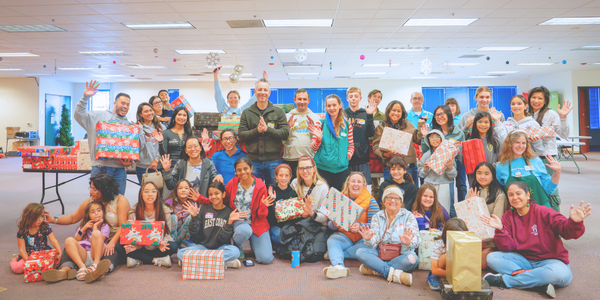
At Family Giving Tree, volunteering often looks like sorting school supplies, building backpacks, or preparing holiday gifts for distribution across the Bay Area.
But what’s happening beneath the surface has an equal impact. People are standing side by side, working toward a shared goal, exchanging small moments of conversation, laughter, and recognition.
Those moments matter.
They create a sense of connection that extends beyond a single shift. And, in many cases, beyond the walls of our Community Hub.
A Different Way to Think About Giving Back
We often think of volunteering as something we do for others. And it is.
But it is also something we do for ourselves.
In a time when disconnection can feel like the default, choosing to show up—physically, intentionally, and together—can be one of the most meaningful things we do.
Because sometimes, the simple act of being in community is not just helpful—it’s essential.
Get Involved
This National Volunteer Month, we invite you to be part of that connection.
Whether it’s your first time volunteering or one of many, there is a place for you here and a community waiting to welcome you.
Learn how you can get involved below!